
Safe Ministry
The Anglican Diocese of Newcastle is committed to ensuring that all people who participate in our worship, programs and ministries have a safe and rewarding experience. God has commanded us to love one another. Ensuring a person’s safety is an expression of that love. The overarching parish safety policy and its key components can be accessed [HERE]
Detailed information in regard to our policies and procedures in relation to screening, training and compliance can be found [HERE].
The Anglican Diocese of Newcastle takes allegations of misconduct and abuse seriously. We encourage victims of crime to contact NSW Police.
We encourage people with concerns to come forward and speak with the Director of Professional Standards (1800 774 945) dps@newcastleanglican.org.au. Survivor Support
Acknowledgement of Country
We acknowledge the First Australians with gratitude for their stewardship of country. In our Parish, we recognise the strength, resilience and continuing culture of the Awabakal and Darkinjung people, and affirm our commitment to walking together in a spirit of truth-telling, justice and reconciliation.


Shop 1, 550 Pacific Highway Belmont
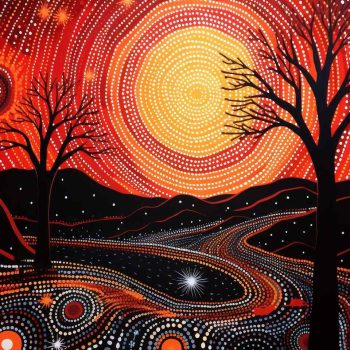
Country
When the Parish Acknowledgement of Country was recently updated, the term ‘country’ was used specifically with this idea of meaning deeply embedded in it. The words of that acknowledgement read: Acknowledgement of Country We acknowledge the First Australians with gratitude for their stewardship of country. In our Parish, we recognise the strength, resilience and continuing...Continue reading→

The Funeral Look
The Funeral Look I recently attended the funeral of a longstanding friend in a rural community. I had known the lady for nearly forty years, and as I stood there, I recalled that we had first met when I was helping with arrangements for her mother’s funeral. Naturally enough, I reflected for a moment on...Continue reading→
East Lake Macquarie Anglican Church.
Welcoming All as friends.
The Parish of East Lake Macquarie welcomes you to our website and we invite you to join us at our services, activities, and events.
Sharing a Vision.
Our vision is to be a united group of welcoming Christian people, celebrating and sharing our faith with joy, respect, and care.
Walking Together.
We are gently moving forward together to embrace new possibilities in an ever-changing world.
Using social media allows us to reach out and further share our faith, extending the hand of Christ in new ways.
This is a lively, vibrant Parish and there is always something happening across our three centres. There are regular Services held in Belmont, Windale, and Swansea as well as some of the local aged care homes. We are grateful to a large group of dedicated volunteers who share their energy and time in a variety of ways. East Lake Macquarie Anglican Church has three great Op Shops in Redhead, Belmont North, and Windale which are all well-supported and play an important role in the local community. In addition, we also have the Merrigum Centre operating out of our Windale centre, putting God’s love into action and providing food assistance to those in need every Wednesday morning as well as social interaction and friendship.
Celebrating Special Occasions:
Baptisms and Weddings are special occasions and wonderful celebrations, so we take great joy in being part of these celebrations. I encourage you to talk to us about times, dates, and ways that we can work together to make your event special and individual. Life also brings a range of challenges, hurt and loss, we hope to provide a place where everyone can feel supported and cared for.
If the website does not offer the information, you are looking for, please contact us via the contact page or phone us to arrange a time for a chat.
Blessings!
Fr Peter
Parish Priest.
Anglican Parish of East Lake Macquarie.
“Peace be to you, and peace be to your house, and peace be to all that you have”.
1 Samuel 25:6
The Restoration of Adam
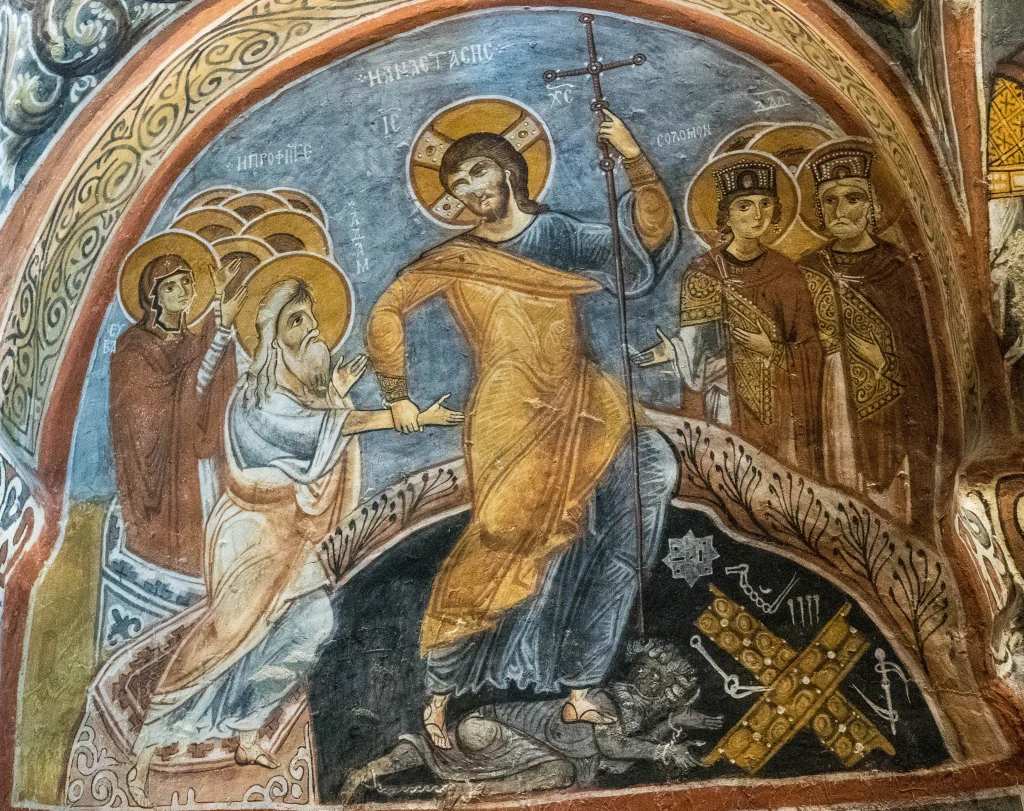
The Restoration of Adam
Much of the story of faith comes from Ancient times, and sometimes there are things we find that have been tucked away in our history, and perhaps nearly forgotten. The region of Cappadocia has been recently in the news, crossing the boundary between modern Turkey and Syria, and being subject to a string of earthquakes and a humanitarian crisis.
We should perhaps know more about this region than we do, as in the 4th century 3 famous Bishops, Basil the Great, Gregory of Nazianzus and Gregory of Nyssa, worked together on the theology of the Church and at the 1st Council of Constantinople the substantive text of the Nicene Creed was adopted, pretty much as we say it Sunday by Sunday to this day.
This region also has held a part of the resurrection memories of the Church in the Icon, the Restoration of Adam. Icons are of course written, not painted, because they tell a story, and are not to be looked at, but to be read, or gazed through as the windows of heaven.
In the icon, we notice some features depicted that may seem unfamiliar to many, especially those of us who are used to Western images.
- Jesus is not standing, but moving forward, with his robes flowing and his feet apart.
- Christ is holding Adam by the arm, and he is being pulled along by Jesus. The victory of Jesus over death is for all of humankind, beginning symbolically with Adam, and restoring us all to our place in the garden before the fall.
- In the mid-ground, we see Kings and Prophets from the Old Testament gazing on depicted as well as this is their redemption as well.
- At Christ’s feet, the Gates of Hades have been broken in the shape of a cross, telling us that it is by the cross Jesus has entered into Hell, and Satan now lies bound and defeated in his own chains.
The Creation Stories in Genesis are described by some as simply factual accounts, and by others as allegorical or symbolic stories. The icon here shows that this approach is not a novelty, but rather has a long and valid history.
The Restoration of Adam
Some of this has been caught in the James McAuley Hymn
By Your Kingly Power, O Risen Lord
By your kingly power, O Risen Lord,
All that Adam lost is now restored:
In your resurrection be adored.
Sing the joyful Easter cry,
sound it to the souls in prison,
Shout our triumph to the sky:
Sing Christ risen, sing Christ risen.
Sing the joyful Easter cry,
let all times and peoples listen:
Death has no more victory,
Sing Christ risen, sing Christ risen.
By J. McAuley © 1976
Holy Week & Easter 2023
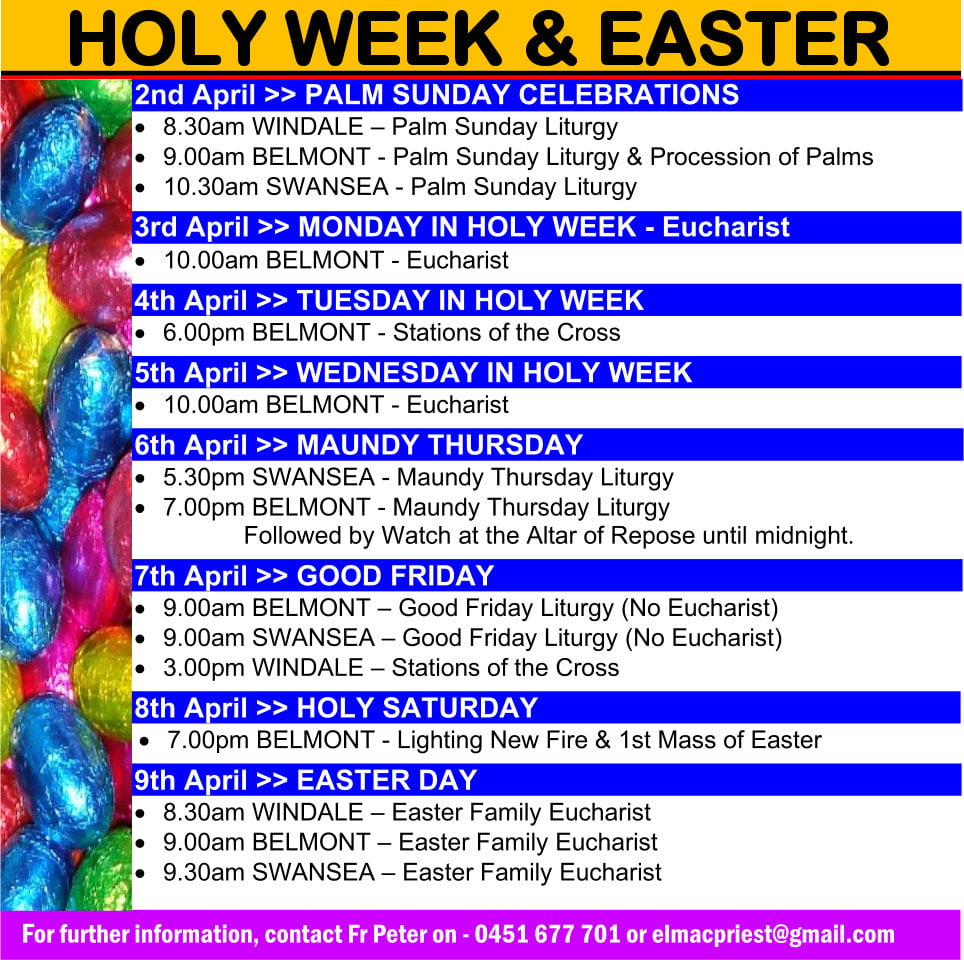
Palm Sunday - April 2
8:30 am Windale - Palm Sunday Liturgy
9:00 am Belmont - Palm Sunday Liturgy and Procession of Palms
10:30 am Swansea - Palm Sunday Liturgy
Monday in Holy Week - April 3
10:00 am Belmont - Eucharist
Tuesday in Holy Week- April 4
6:00 pm Belmont - Stations of the Cross
Wednesday in Holy Week - April 5
10:00 am Belmont - Eucharist
Maundy Thursday - April 6
5:30 pm Swansea - Mauny Thursday Liturgy
7:00 pm Belmont - Maundy Thursday Liturgy followed by Watch at the Altar of Repose until midnight.
Good Friday - April 7
9:00 am Belmont - Good Friday Liturgy - no Eucharist
9:00 am Swansea - Good Friday Liturgy - no Eucharist
3:00 pm Windale - Stations of the Cross
Holy Saturday - April 8
7:00 pm Belmont - Lighting New Fire and 1st Mass of Easter
Easter Day - April 9
8:30 am Windale - Easter Family Eucharist
9:00 am Belmont - Easter Family Eucharist
9:30 am Swansea - Easter Family Eucharist
Rose Vestments
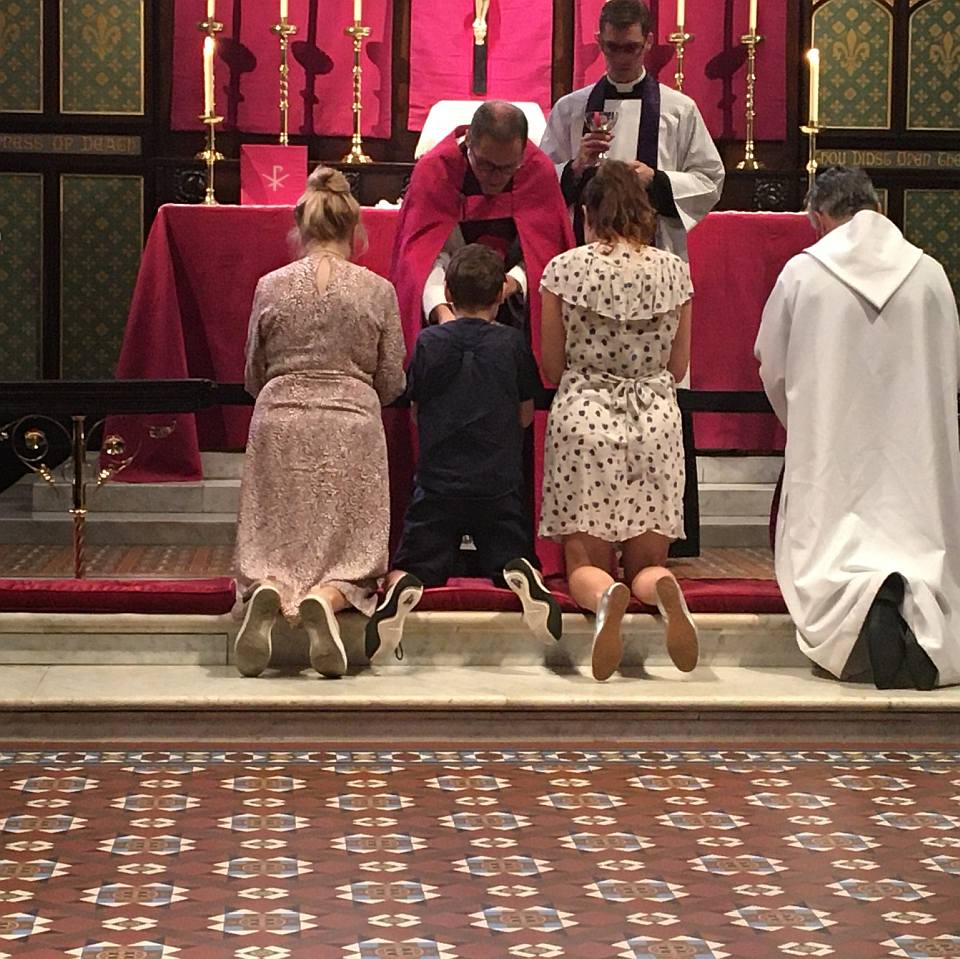
Rose Vestments
Lent 4, the 4th Sunday of Lent, is also known as Refreshment Sunday or Mothering Sunday and is also called Laetare Sunday.
For some, this comes as a bit of a surprise, however, in the earlier rites the introit or entrance sentence for the day came from Issaiah 66:10-11
Rejoice with Jerusalem, and be glad for her,
all you who love her;
rejoice with her in joy,
all you who mourn over her—
that you may nurse and be satisfied
from her consoling breast;
that you may drink deeply with delight
from her glorious bosom.
The Latin word for rejoice here was Laetare, which is how this Sunday got that name.
It was also a day of minor reprieve from the austerity of Lent, clearly associated with the tradition of Simnel Cake, often handed out on this day.
It was often a day when folk would travel to their homes, and their home parishes, and so became called Mothering Sunday, in association with visiting Mothers, or Mother’s Graves, or the Mother Church from which people were baptised.
This year in some parts of the Parish people saw the clergy in Rose (pink) Vestments and some people observed that they had never seen that before.
Some parts of Anglicanism refrain from using liturgical colours, which in the main people have been used to four or five colours, (Purple, Green, Red, and White/Gold). Some of us have also seen the use of Black Vestments, as were used for the funeral of Queen Elizabeth II last year.
The Orthodox Eastern Christians use a great deal of colour, though not in the seasonal way that Christians in the West do.
The early Sarum rites (Old English / Celtic) made a great deal of the use of colours in the liturgy. It is most probable that following the Augustinian MIssion to England the use of liturgical colour made its way back to Rome and Europe more generally. The Sarum Colour for Advent was the deep ashen blue of the night sky. The Third Sunday of Advent, Gaudate Sunday was called also for the Introit from Philippians 4:4-7
Rejoice in the Lord always; again I will say, Rejoice. Let your gentleness be known to everyone. The Lord is near. Do not worry about anything, but in everything by prayer and supplication with thanksgiving let your requests be made known to God. And the peace of God, which surpasses all understanding, will guard your hearts and your minds in Christ Jesus.
The Latin word here for rejoice was Gaudete, which is how this Sunday got that name.
The colour of the day in the Sarum rite was Rose, and seen as the promise of the sunrise against the night sky, as we observe if we are up that late, or that early, just before the dawn arrives. The use of Rose on Laetere Sunday seems to be a transference of that same logic to the minor relaxation of the Lenten Fast.
So the use of Rose Vestments is not a new thing, nor is it un-Anglican, but rather firmly part of the historic tradition in which we stand that goes back well before Augustine set foot on English soil.
Rose vestments should remind us that the dawn is coming, the Resurrection is around the corner, and we are called to live as people of hope.
This is My Tribe

Tribe
A now-forgotten sage old priest would declare, “There are three B’s to being Christian, Believe, Belong and Behave”. Interestingly he took the view that these things did not happen in a particular order, and that one was not more important than the other.
The notion of Tribe carries with it an implicit understanding of belonging. The sense of Tribe has a sense of belonging and identity that recognises a commonality without imposing sameness. This is an important aspect of Tribe because we do not lose our identity in being part of the tribe, but rather we gain a deeper understanding of our own identity. In fact, one of the dilemmas we face here is the question, is the tribe defined by its members, or is it the tribe that makes its members who they are?
In part, the story of Ruth in the Old Testament is about the understanding of the Tribe. Ruth begins her life as a Moabite woman, who marries one of Naomi’s sons. Following the death of Naomi’s husband and sons, Ruth makes a determined statement to stay with Naomi. Ultimately she becomes the Great Grandmother of David, Israel’s first King. One of the beautiful things about a lot of the early patriarch narratives in the Old Testament is that they carry a certain messiness. Those who talk of David’s line, with an absolute sense of Tribal purity are confronted with the brute reality that David’s Grandmother was a Moabite woman.
In this sense, the tribe is not absolutely fixed or final and is not an impregnable barrier, but rather a permeable membrane, always open to new members. As a Parish Church Community, we have a sense of Tribe. Our challenge is to form such a sense of community, that some of those who encounter us will find some welcome, some inclusion, and some sense of belonging, that they might find themselves saying, ‘these are my people, and this is my tribe’.
Now there were several steps in the process for Ruth in moving to become the Grandmother of David, and ultimately there was a sense of the process. So too, for all of us, there are steps along the way. We might be struggling with the sheer act of believing, We may be struggling with the content of what we may believe. We, all of us, wrestle with our own behaviour, in one way or another (for all have sinned and are falling short of the glory of God). We are not perfect, yet.
Moltmann made the suggestion that we are called to believe in God as Creator, not in God as the retired Creator. God is active in shaping and creating each of us, and indeed in shaping and forming all of us. The notion of tribe is not a static, institutional or corporate structure, but rather a living and breathing body. It is a process or a journey.
As we approach the greatness of Holy Week, We see Jesus as the ultimate expression by God of his solidarity with humankind.
In Jesus God is saying “these are my people and this is my tribe.” And indeed when asked what they are worth to him we discover it is everything. We are they who simply respond to God’s commitment to us, “these are my people and this is my tribe.”
Lent

Lent is the traditional season of preparation for the great celebration of Easter.
This is often marked as a season of fasting, where things are given up and taken up to help us on our spiritual journey.
The name Lent comes from the Middle-English word Lente which means springtime, which in turn owes its origins to Early-English Lencten and the Saxon word the same which meant ‘longer’ and indeed referred to the season where the days were getting longer.
Lent is typically described as forty days and is seen as referencing the forty days Jesus was fasting in the wild. Matthew 4:1-11.
The first day of Lent is Ash Wednesday, and in 2023 that is the 22nd of February and Easter Day falls on the 9th of April. And a quick calculation will show you that it is 47 days. There are two explanations for that. Either from Palm Sunday you have entered Holy Week, or as Sunday is always a celebration of the Resurrection you don’t count the Sundays in Lent as part of Lent.
Easter is a season of Fifty days, culminating at Pentecost, and of course there the Sundays are counted as part of the festival.
Lent begins with Ash Wednesday, and the theme for that day comes from the first reading from Joel:
Return to the Lord, your God, for he is gracious and merciful, slow to anger, abounding in steadfast love, and relents from punishing.
In the liturgical cycle, we come to this year by year, and the challenge for us is to realise that this can always be new for us. As we grow the same crop on the same land, we realise that each year we have a new harvest, yet perhaps different from last year.
There is the story of the wife who asks her husband “what are you going to do today?” and he replies “nothing!” she responds “that's what you did yesterday”, and he replies “I wasn’t finished!”
Our challenge is to encounter in the familiar ritual the freshness of the unfinished business, open to a new discovery in the old familiar ritual, the realisation that the Gospel is Good News, not stale history.
So we encourage you to have a Happy Lent, and that in this time you may have the joy of finding some new spiritual depth on this journey to the Cross and Resurrection.
Diary Dates

August 2024
20: Ripples of Hope
All Saints Belmont 5:00 Pm
25 | New Guinea Martyrs
September 2024
Season of Creation
2 | Creation Sunday
Merrigum Op Shop
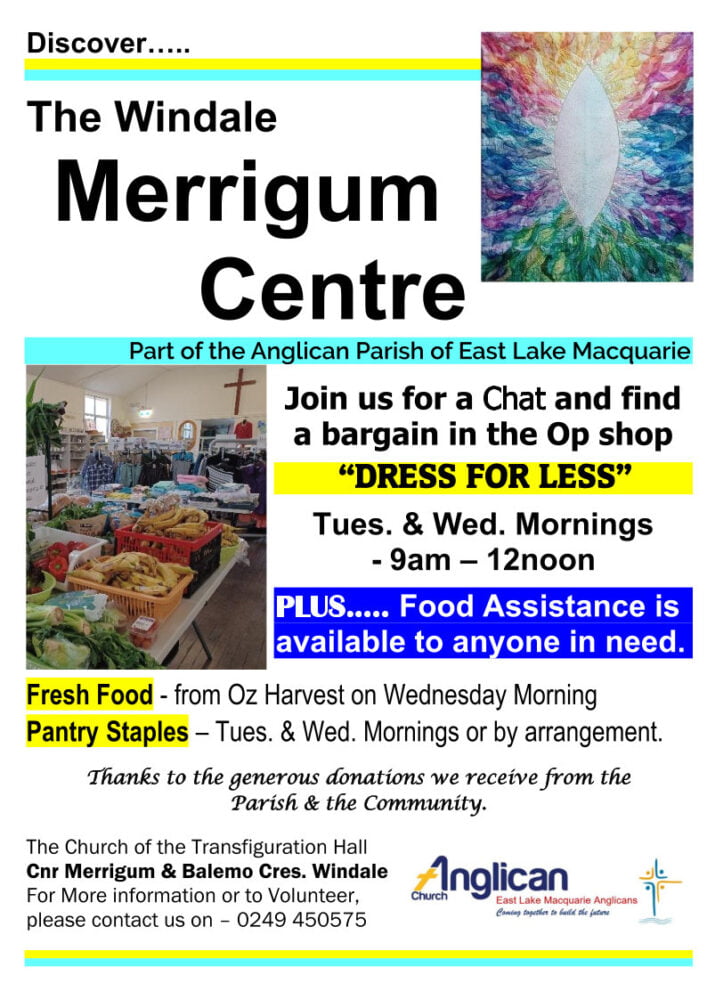
Discover…..
The Windale Merrigum Centre
Part of the Anglican Parish of East Lake Macquarie
Join us for a Chat and find a bargain in the Op Shop.
Currently, we are not able to offer Tea and coffee.
“DRESS FOR LESS”
Tues. & Wed. Mornings - 9 am – 12 noon
PLUS….. Food Assistance is available to anyone in need.
Fresh Food - from Oz Harvest on Wednesday Morning
Pantry Staples – Tues. & Wed. Mornings or by arrangement.
Thanks to the generous donations we receive from the
Parish & the Community.
The Church of the Transfiguration Hall
Cnr Merrigum & Balemo Cres. Windale
For more information or to Volunteer, please contact us. ph – 0249 450575
The Font – Christmas 2022

As we come to the end of our first calendar year in this wonderful East Lake Macquarie Parish I am heartened and encouraged by the distance we have journeyed in that time. Just as the Magi were called to follow the star we too are asked to move forward with Christ.
Sometimes it can be hard to move away from what we are used to, but it is the nature of our faith and our Christian journey. As part of building for the future, we need to work together to ensure that this Parish maintains relevance and viability extending Christ’s love into the community.
The Christmas story is about the birth of a baby, a baby that was thought to be truly special; people had looked forward to this child for centuries, and they had told stories of who he would be, and what he would do. He was born just like you and me, not a myth or a legend and, in his humanity, he shares our own struggles and challenges.
They believed that he would come and usher in a new world, one marked by justice and peace; and even though we don’t always see lots to encourage that thought, those of us who believe remain hopeful and we continue to do our best to follow the star.
May the God of hope fill you with all joy and peace in believing, so that you may abound in hope by the power of the Holy Spirit. Romans 15:13
This Christmas, I encourage you to join us at our services, to share the celebration of that tiny child who brings each of us God’s message of Hope, Peace, Joy, and Love. May you and those you care for have a blessed and joyous Christmas.
Father Peter
