
Transfiguration
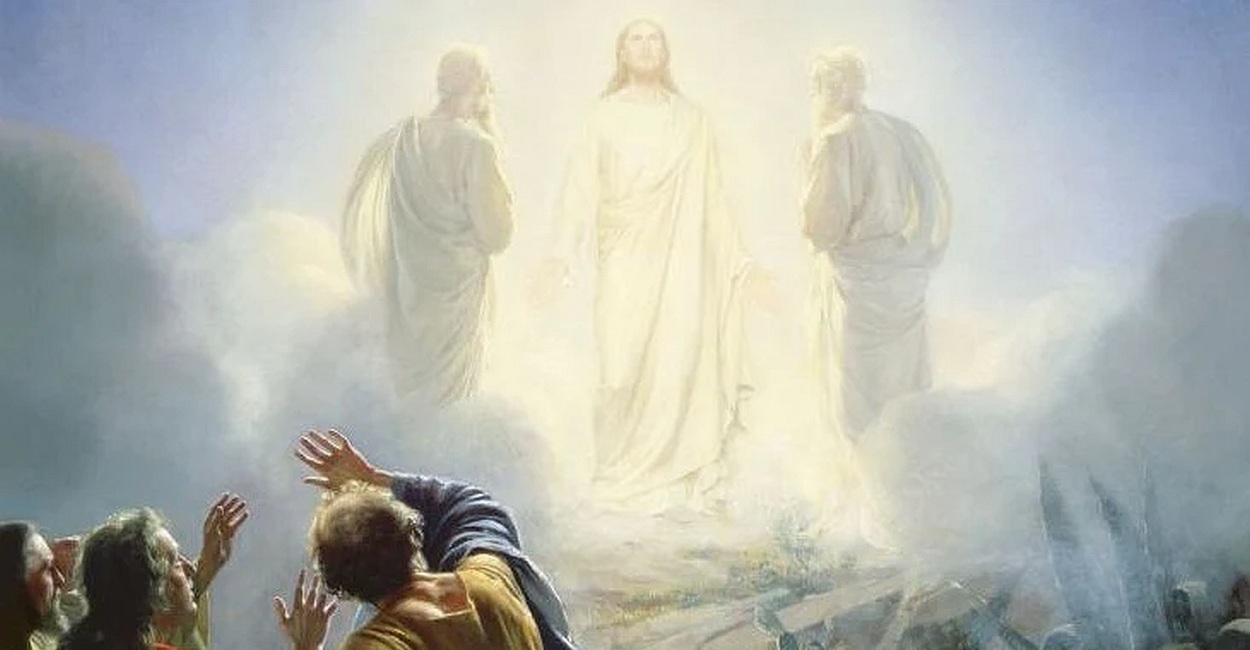
The Transfiguration is recorded in the three synoptic Gospels with great consistency. Given that, it is interesting that, growing up in the period of the Book of Common Prayer, basically before 1979, most of us knew little of the Feast. It is listed as a Minor Festival with readings set for Morning and Evening Prayer on August 6th each year, and not transferred to a Sunday following, so you might have caught it in private reading, or one year in seven on the Sunday. In contemporary Lectionaries it may be celebrated on the Sunday before Ash Wednesday, or perhaps the 2nd Sunday in Lent, or on the 6th of August, and may be celebrated within the Octave. It also now has a Collect and reading set for the three-year cycle. The chances are we will hear something about it every year.
Of course, in the Parish of East Lake Macquarie, our centre at Windale is dedicated to the Transfiguration of the Lord. This is a bit special, as aside from the Church on Mt Tabor, very few Churches share this dedication.
Matthew
The Transfiguration
17 Six days later, Jesus took with him Peter and James and his brother John and led them up a high mountain, by themselves. 2 And he was transfigured before them, and his face shone like the sun, and his clothes became bright as light. 3 Suddenly there appeared to them Moses and Elijah, talking with him. 4 Then Peter said to Jesus, “Lord, it is good for us to be here; if you wish, I will set up three tents here, one for you, one for Moses, and one for Elijah.” 5 While he was still speaking, suddenly a bright cloud overshadowed them, and a voice from the cloud said, “This is my Son, the Beloved; with him I am well pleased; listen to him!” 6 When the disciples heard this, they fell to the ground and were overcome by fear. 7 But Jesus came and touched them, saying, “Get up and do not be afraid.” 8 And when they raised their eyes, they saw no one except Jesus himself alone. As they were coming down the mountain, Jesus ordered them, “Tell no one about the vision until after the Son of Man has been raised from the dead.”
Mark
The Transfiguration
2 Six days later, Jesus took with him Peter and James and John and led them up a high mountain apart, by themselves. And he was transfigured before them, 3 and his clothes became dazzling bright, such as no one on earth could brighten them. 4 And there appeared to them Elijah with Moses, who were talking with Jesus. 5 Then Peter said to Jesus, “Rabbi, it is good for us to be here; let us set up three tents: one for you, one for Moses, and one for Elijah.” 6 He did not know what to say, for they were terrified. 7 Then a cloud overshadowed them, and from the cloud there came a voice, “This is my Son, the Beloved; listen to him!” 8 Suddenly, when they looked around, they saw no one with them any more, but only Jesus.9 As they were coming down the mountain, he ordered them to tell no one about what they had seen, until after the Son of Man had risen from the dead. 10 So they kept the matter to themselves, questioning what this rising from the dead could mean.
Luke
The Transfiguration
28 Now about eight days after these sayings Jesus took with him Peter and John and James and went up on the mountain to pray. 29 And while he was praying, the appearance of his face changed, and his clothes became as bright as a flash of lightning. 30 Suddenly they saw two men, Moses and Elijah, talking to him. 31 They appeared in glory and were speaking about his exodus, which he was about to fulfill in Jerusalem. 32 Now Peter and his companions were weighed down with sleep, but as they awoke they saw his glory and the two men who stood with him. 33 Just as they were leaving him, Peter said to Jesus, “Master, it is good for us to be here; let us set up three tents: one for you, one for Moses, and one for Elijah,” not realizing what he was saying. 34 While he was saying this, a cloud came and overshadowed them, and they were terrified as they entered the cloud. 35 Then from the cloud came a voice that said, “This is my Son, my Chosen; listen to him!” 36 When the voice had spoken, Jesus was found alone. And they kept silent and in those days told no one any of the things they had seen.
Divinity
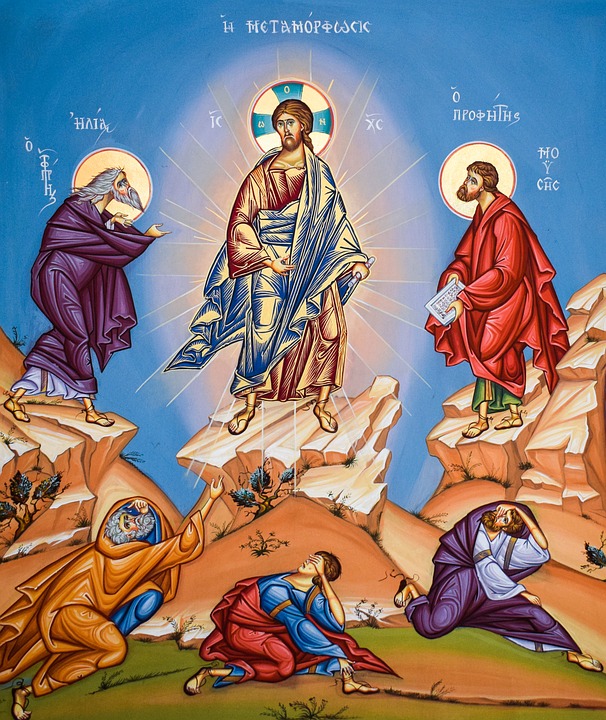
The essence of the story is the account of the revelation of the divine nature of Jesus to Peter, James and John on a Mountain (probably Mount Tabor). In company with Jesus, there appear Moses and Elijah.
Peter immediately wants to capture the moment; then the voice declares, "This is my Son, listen to him". Then the whole thing is over, and going down the mountain, Jesus tells them not to tell anyone till later.
Humanity
The Transfiguration is a hinge in the Synoptic Gospels. Up until this point, the mission of Jesus is an itinerant ministry of preaching, teaching and healing. From this point, the purposes of Jesus turn to Jerusalem, the Crucifixion and the Resurrection.
It seems that Jesus gains from this moment the ultimate glimpse of the goal and purpose in order to draw the strength required for the road ahead. The Transfiguration affirms not simply his divinity, but also his humanity.
John
Given that the three Synoptic Gospels record the Transfiguration specifically, and the narrative serves as the hinge in their accounts of Jesus, you may wonder why John's Gospel does not include such an account, especially given that John was one of the people on the mountain. It is not that there is no hinge in John's Gospel, but rather that the hinge in John's Gospel is in the Raising of Lazarus.
John's Gospel is different to Matthew, Mark and Luke, as it is less concerned with historical order, and more driven to demonstrate who Jesus is in a profound theological sense. Profoundly, the fourth gospel is written in light of the Transfiguration.
John 1:14-18 | And the Word became flesh and lived among us, and we have seen his glory, the glory as of a father’s only son, full of grace and truth. (John testified to him and cried out, “This was he of whom I said, ‘He who comes after me ranks ahead of me because he was before me.’ ”) From his fullness we have all received, grace upon grace. The law indeed was given through Moses; grace and truth came through Jesus Christ. No one has ever seen God. It is the only Son, himself God, who is close to the Father’s heart, who has made him known.
John 1:19-20 | This is the testimony given by John when the Jews sent priests and Levites from Jerusalem to ask him, “Who are you?” He confessed and did not deny it, but he confessed, “I am not the Messiah.” And they asked him, “What then? Are you Elijah?” He said, “I am not.” “Are you the prophet?” He answered, “No.”
John's Gospel is written in light of the Transfiguration, and his purpose is to answer the question "Who is Jesus?" This is slightly different to the synoptics who seek to tell what Jesus did.
Moses and Elijah
The two Old Testament figures who appear with Jesus are Moses and Elijah. These two are not accidental and add their own weight to the importance of the account.
In Jewish exposition of the scriptures, there was a requirement that there were two witnesses, one from the Law and one from the Prophets. Moses and Elijah fulfil that purpose absolutely.
Moses does not have a grave, as he wandered off into the desert as Joshua led the people into Judea.
Elijah has no grave, as he was carried to heaven in a chariot of fire.
Moses and Elijah are central to Jewish eschatological hope and expectations of the end time.
Jesus
Like Moses, Jesus is a Lawgiver.
Like Elijah, Jesus is a prophet calling the nation to account.
Like Moses and Elijah, Jesus has no grave (just a borrowed tomb he no longer requires).
Eschatology, often thought of as the study of the end times, is really about the meeting of time and eternity. The Transfiguration is an Eschatological moment recorded in the Gospels, and it underlines for us that the encounter with Jesus is eschatological.
Jesus is completely human and completely divine. The Transfiguration is a clear window into who Jesus is.
Church
We are the Church; we are called to be the people of Jesus. As people of the Transfiguration, we are called to be people in whom something of the nature of God may be perceived. May be not by everyone, and may be not all the time, and sometimes the mountaintop where this happens may well seem like the valley, yet in some way it will be a mountaintop.