
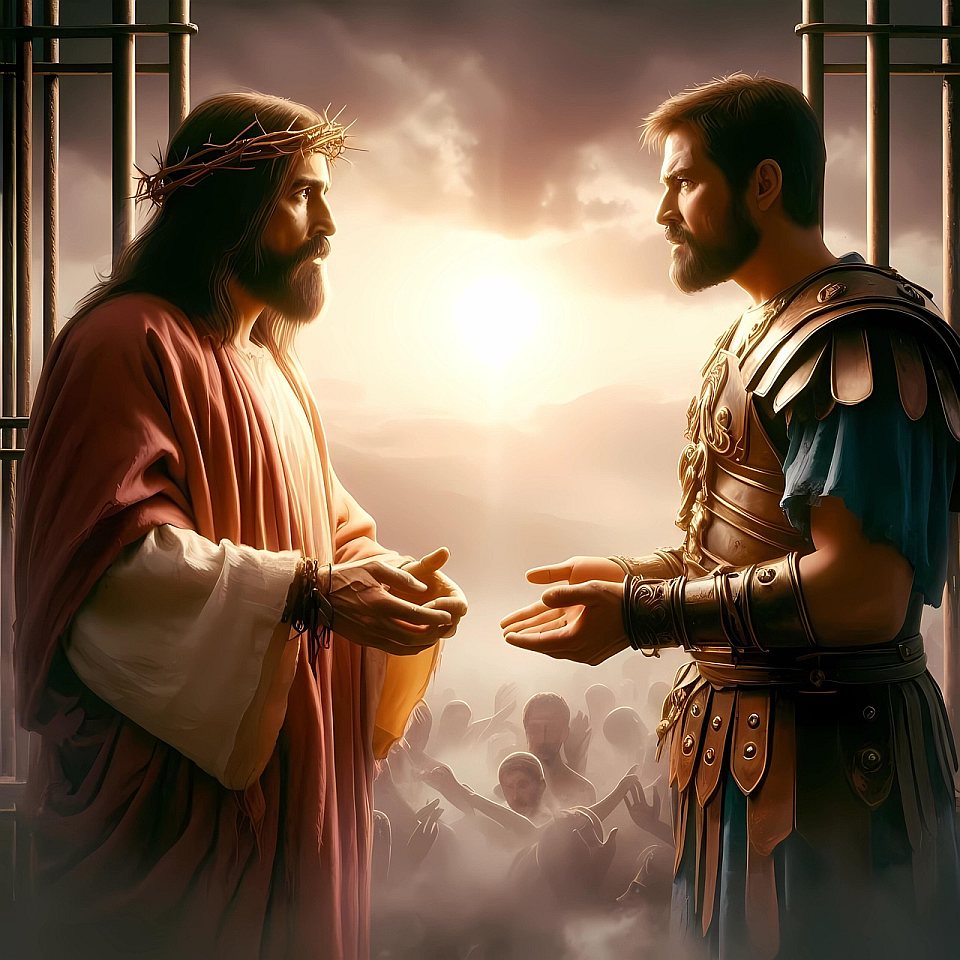
Truth
Jesus before Pilate
Then Pilate entered the praetorium again, summoned Jesus, and asked him, ‘Are you the King of the Jews?’ Jesus answered, ‘Do you ask this on your own, or did others tell you about me?’ Pilate replied, ‘I am not a Jew, am I? Your own nation and the chief priests have handed you over to me. What have you done?’ Jesus answered, ‘My kingdom is not from this world. If my kingdom were from this world, my followers would be fighting to keep me from being handed over to the Jews. But as it is, my kingdom is not from here.’ Pilate asked him, ‘So you are a king?’ Jesus answered, ‘You say that I am a king. For this I was born, and for this I came into the world, to testify to the truth. Everyone who belongs to the truth listens to my voice.’ Pilate asked him, ‘What is truth?’
John 18:33-38
Those of us who go to Church on Good Friday are likely to be familiar with this passage from the Passion according to John. Pilate’s Question - What is truth? - is sometimes lost in the midst of everything else, and of course, the Gospel does not provide Pilate with a neat answer either. At one level, the answer to the question is four chapters back.
Jesus said to him, “I am the way, and the truth, and the life. No one comes to the Father except through me.
John 14:6
Pilate, of course, did not have that information, and for him we can but wonder what the force of the question was as he uttered it.
If you read this passage, especially out loud, there is a question about how you read it. I have heard it read by a student with a real sense of genuine inquiry, and I have heard it read by a sanguine college professor who dropped it with an acid dose of cynicism. It can be read flat and simply dissolve into the text, or highlighted in ways that bring out various shades of meaning.
This led to the question - how did Pilate deliver the question?
Judea was a strategic but problematic appointment for the Roman Empire. While it had significant logistical advantages, it was also one of the most difficult provinces to govern, characterised by constant tension, religious conflict, and costly rebellions.
Judea was Pilate's last significant appointment in the Empire, ending his appointment after issues in Samaria (we today call it the West Bank) around 36-37 AD.
John presents the Jewish leaders as conspiring together to get Pilate to have Jesus put to death. There are several reasons why Pilate resists, including that no Roman Laws have been broken, that it is simply an internal Jewish issue, and that his wife suggests that he shouldn’t. However, the city is overflowing in preparation for the Passover, which falls on a Sabbath, and the three major power forces, the Priests, the Sadducees, and the Pharisees, so often divided, have found a common enemy in Jesus. To placate them and keep the peace, Pilate Consents.
The turning point of the decision seems to be expressed when Pilate exclaims, “What is Truth?” The decision is about expediency and political reality, and has nothing to do with truth. Pilate washes his hands.
And yet, to this very day, the question reverberates through time and again and again we are required to find an answer. AI will provide you with a basic answer.
Truth is defined as conformity to facts, reality, or actuality. It represents the accuracy of statements, beliefs, or propositions in relation to the world as it is. Common interpretations include correspondence with reality, internal consistency, and practical utility, serving as a standard for knowledge, honesty, and evidence-based claims.
https://en.wikipedia.org/wiki/Truth
Maybe such a definition helps, though I doubt that it would have helped Pilate, even if he had it at the time. There is a sense that many of us have that Truth should be both objective and absolute.
Pilate, as John presents him, abandons the pursuit of a higher good and gives way to the mob to resolve the short-term problem of the potential riot.
This same struggle confronts us today, again and again, sometimes more subtly and sometimes with less obvious consequences; it is really the same struggle.
We are confronted with information from an untold number of sources. Some of that information is true, and some of it is true in part, and some of it may be true but told in such a way as to elicit a response from you, some of it is half true and basically biased, and of course, some of it is simply false.
A phrase used by an American President emphasised this problem when he spoke about alternative truth. The phrase itself debases the notion of truth as objective and absolute, making it subjective and relative.
The idea that then can be an alternative to the truth that is also true is problematic, and yet we find people speaking about ‘my truth’. This suggests that there may be parallel truths about the one thing or event.
For us, as Australians, living in the 21st Century, some particular points about this may trouble us. Most of us whose schooling was in the last century were taught that James Cook discovered Australia in 1770. James Cook, who was an excellent seaman and ahead of his time in looking after his crew and their welfare, yet there are some really good questions about the discovery of Australia claim.
- Willem Janszoon (1606): Landed on the western side of Cape York Peninsula in the Duyfken.
- Luís Vaz de Torres (1606): A Spanish explorer who sailed through the strait now bearing his name (Torres Strait).
- Dirk Hartog (1616): Landed on Dirk Hartog Island off Shark Bay, Western Australia.
- Jan Carstensz (1623) explored the Gulf of Carpentaria and named it after the Governor-General of the Dutch East Indies
- Abel Tasman (1642 & 1644): Discovered Van Diemen's Land and mapped northern Australia, calling it New Holland.
- William Dampier (1688 & 1699): The first Englishman to land on the Australian coast.
- Willem de Vlamingh (1696-97): Dutch captain landed on Rottnest Island, and sailed up the Swan River and found Black Swans.
- Makassan Trepangers: Fishermen from Indonesia visited the northern coast (Kimberley/Arnhem Land) for centuries to trade
However, perhaps more than 50,000 years ago, as the evidence now suggests, Australia's first human inhabitants discovered Australia on foot, crossing the land bridge from Asia.
What James Cook did was map a significant part of the East Coast of Australia. Joseph Banks travelled with him on this journey and became a great advocate for the foundation of a colony in what became known as New South Wales.
Another thing we were taught in History was about the Settlement of Australia, which might be understood as the dispossession of the original Australians from their lands, hunting grounds and food sources.
One of the things that the First Australians are asking for is truth-telling. Our History, the songlines of our story that tell us who we are, has been managed in a very colonial, Anglo-friendly way, where the English are always the good people. If we look at the account from the perspective of the first Australians, we may see a different view as the settlers become invaders and the overlanders become thieves of country, food sources and hunting grounds.
For generations, we have ignored the frontier wars, where tribal groups joined forces to struggle against the colonialists. We did not learn about this in school, and many of us to this day have but a scant understanding of it. Today, there is a new struggle in the History Wars to talk about these things with greater honesty. If we are serious about reconciliation, or makarata, then we know this is a prerequisite for us to walk into the future together,
This, of course, leads us back to Pilate’s Question: What is Truth?!